

When you drive a Mazda, you’re experiencing the result of an engineering philosophy that refuses to compromise. SKYACTIV technology represents Mazda’s answer to a question most automakers thought impossible: how do you build a car that’s genuinely fuel-efficient and genuinely fun to drive? The answer was to rethink everything — engines, transmissions, body structure, and chassis — from the ground up.
What Is Mazda SKYACTIV Technology?
Most automakers treat fuel economy and performance as a tradeoff — you get one by sacrificing the other. Mazda’s engineers rejected that premise entirely. SKYACTIV technologies are engineered together so that what makes your Mazda more efficient also makes it lighter, stiffer, and better to drive.
What Does Each SKYACTIV System Do?
SKYACTIV-G
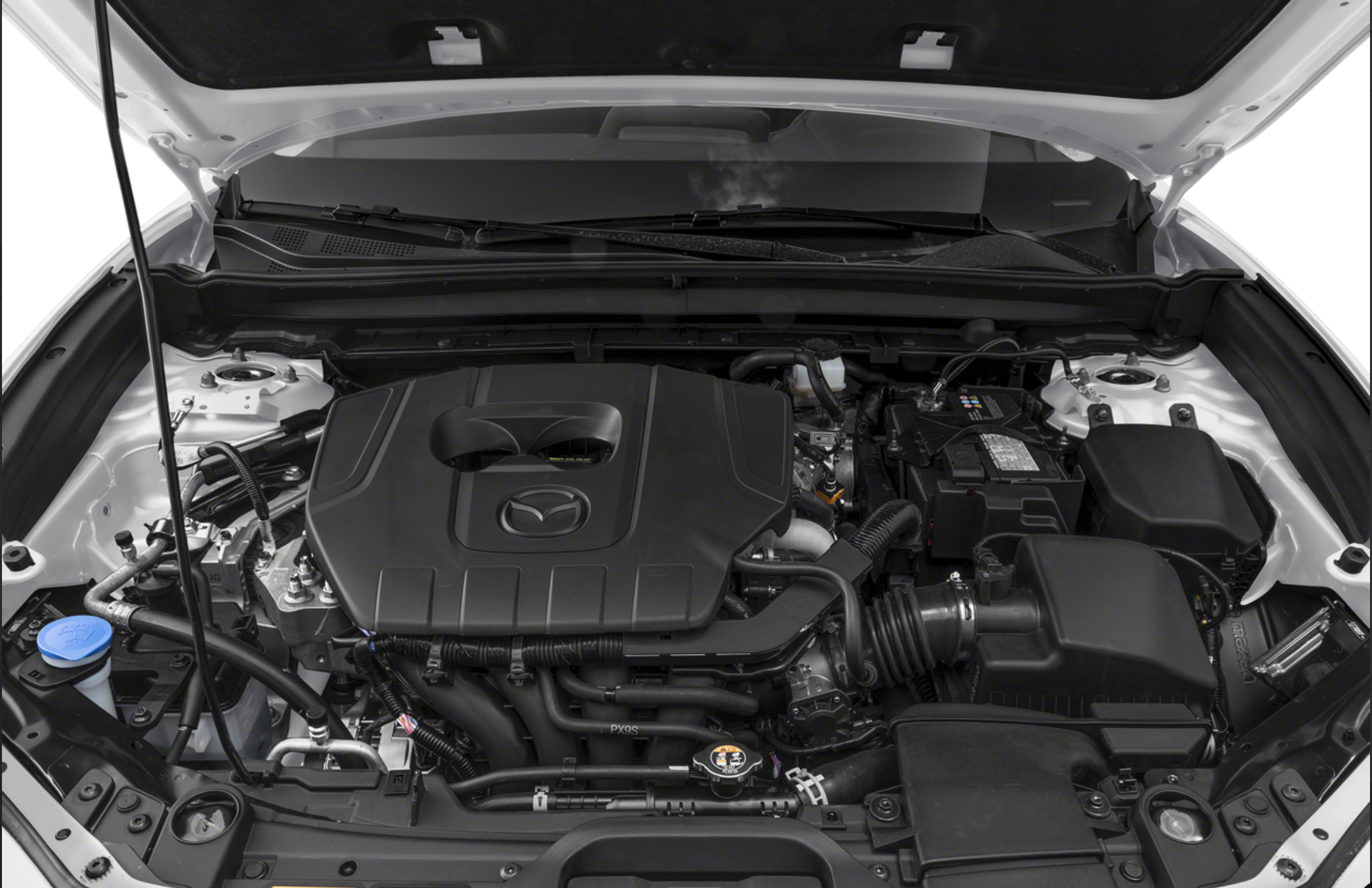
High-compression gasoline engine that extracts more energy from each combustion cycle. Runs at 13:1 compression or higher — well above the industry norm — for better efficiency without a hybrid system.
SKYACTIV-Drive
6-speed automatic calibrated for quick, smooth shifts that keep the engine in its optimal power range. Wider lock-up range than conventional automatics means less energy lost to the torque converter.
SKYACTIV-Body
Ultra-high-tensile steel construction that’s lighter than conventional steel yet significantly stiffer. Less weight means better fuel economy; more rigidity means better crash protection and handling precision.
SKYACTIV-Chassis
Optimized suspension geometry tuned to work with the lighter body. The result is more responsive steering, better ride quality over rough roads, and a lower center of gravity.
How Does the SKYACTIV-G Engine Work?
The SKYACTIV-G gasoline engine’s defining feature is its high compression ratio. Compression ratio describes how tightly the engine squeezes the air-fuel mixture before igniting it — the higher the ratio, the more energy extracted from each combustion event.
Most conventional gasoline engines run compression ratios between 10:1 and 12:1. At higher ratios, the mixture tends to ignite before the spark plug fires — a problem called engine knock — which limits how far engineers can push conventional designs. Mazda’s engineers solved this through exhaust gas recirculation, revised combustion chamber geometry, and multi-hole injectors, allowing the SKYACTIV-G to run at 13:1 or higher without knock.
The payoff: you get more power per unit of fuel, without adding the cost and complexity of a hybrid system.
What Makes the SKYACTIV Transmission Different?
The SKYACTIV-Drive 6-speed automatic is calibrated for one goal: keeping the engine in its optimal power range as much of the time as possible. It achieves this through a wider torque converter lock-up range than conventional automatics — meaning the transmission mechanically connects engine to wheels more of the time, reducing energy lost as heat.
The result is shifts that feel crisp and controlled, whether you’re merging onto I-94 or navigating Kalamazoo’s side streets. You feel the engine working with the transmission, not fighting it.
How Does SKYACTIV Affect the Body and Chassis?
Weight is the enemy of both performance and fuel economy. Mazda’s SKYACTIV-Body uses ultra-high-tensile steel in key structural areas — a material that allows engineers to use less steel in the right places while increasing overall body rigidity. The result is a body that’s lighter than conventional designs and significantly stiffer.
That stiffness matters for two reasons. First, a rigid body transfers driver inputs to the wheels more directly, so the car responds more precisely to steering and braking. Second, a stiffer structure is better at managing crash energy — which is part of why Mazda consistently leads IIHS safety ratings. The SKYACTIV-Chassis then takes advantage of the lighter, stiffer body with optimized suspension geometry tuned for better handling balance and a more controlled ride.
What Is G-Vectoring Control?
G-Vectoring Control (GVC) is one of SKYACTIV’s most technically sophisticated features — and one of the least visible to the driver. The system makes tiny adjustments to engine torque in response to steering inputs.
When you begin a corner, GVC momentarily reduces engine torque. This shifts weight forward onto the front tires, increasing front grip and improving turn-in precision. As you exit the corner and straighten out, torque returns to normal, which shifts weight rearward to stabilize the car. The changes happen in fractions of a second and are imperceptible individually — but the cumulative effect is a car that feels more planted, more balanced, and more intuitive to drive than the hardware alone would suggest.
Mazda spent eight years developing GVC. Drivers often describe it as making the car feel like a natural extension of their movements rather than something they’re operating. It comes standard on every current Mazda model.
What’s Next for SKYACTIV Technology?
Mazda continues evolving the SKYACTIV platform in two directions simultaneously. Electrification is expanding through M-Hybrid Boost mild-hybrid systems (now standard on the CX-70 and CX-90 inline-6) and full plug-in hybrid powertrains — the CX-90 PHEV delivers 323 combined horsepower with a 2.5-liter engine and electric motor.
Mazda is also developing the SKYACTIV-Z engine, which promises even greater combustion efficiency while meeting stricter global emissions standards. The SKYACTIV-Z continues Mazda’s approach of extracting more from gasoline combustion before defaulting entirely to electrification — a philosophy that keeps the driving experience at the center of every engineering decision.
Experience SKYACTIV Technology at LaFontaine Mazda Kalamazoo
Every new Mazda on our lot — from the Mazda3 to the CX-90 — runs on SKYACTIV technology. The best way to understand what it means in practice is to drive one. Our team serves buyers from across Southwest Michigan, including Portage, Battle Creek, Grand Rapids, Holland, and Allegan.
Ready to feel the difference SKYACTIV makes?
View New Mazda Inventory Schedule a Test Drive Get Pre-ApprovedFrequently Asked Questions: Mazda SKYACTIV Technology
What is Mazda SKYACTIV technology?
Mazda SKYACTIV is a comprehensive engineering platform covering engines, transmissions, body structure, and chassis. It is designed so that every system works in harmony — extracting maximum efficiency and performance without requiring buyers to choose between fuel economy and a genuinely engaging drive.
What does SKYACTIV mean on a Mazda?
On a Mazda, SKYACTIV refers to the brand’s core engineering technologies. A SKYACTIV-G engine runs a higher compression ratio than conventional engines for better fuel efficiency. A SKYACTIV-Drive transmission shifts more responsively. A SKYACTIV-Body uses ultra-high-tensile steel for a lighter, stiffer structure. Together, they make every Mazda more efficient, safer, and more engaging to drive.
What SKYACTIV engine is in the Mazda CX-5?
The Mazda CX-5 uses the 2.5-liter SKYACTIV-G four-cylinder engine, producing 187 horsepower and 186 lb-ft of torque. A turbocharged 2.5T version delivering 256 horsepower is available on upper trims. Both engines are paired with the SKYACTIV-Drive 6-speed automatic.
Is SKYACTIV technology the same as a hybrid?
No. Standard SKYACTIV is not a hybrid system — it is a conventional gasoline engine and drivetrain engineered for higher efficiency through better combustion, lighter body structure, and smarter transmission tuning. Mazda does offer hybrid systems separately: M-Hybrid Boost mild-hybrid technology and full plug-in hybrid (PHEV) powertrains on the CX-70 and CX-90.
Why do engineers admire Mazda SKYACTIV technology?
Engineers value SKYACTIV because Mazda solved a problem that stumped most automakers: achieving a very high compression ratio in a gasoline engine without engine knock. Most engines run 10:1 to 12:1 compression; SKYACTIV-G runs at 13:1 or higher. This extracts more energy from each combustion event, improving fuel economy without adding hybrid complexity or cost.
Which Mazda models have SKYACTIV technology?
All current Mazda models include SKYACTIV technology. The Mazda3, CX-30, CX-5, and CX-50 use the SKYACTIV-G four-cylinder engine. The CX-70 and CX-90 use a SKYACTIV inline-6 with M-Hybrid Boost mild-hybrid technology. The CX-70 PHEV and CX-90 PHEV add a plug-in hybrid powertrain on the same SKYACTIV platform.
Connect with us

